Founder story · Klippr By Ayush
I built an AI clip studio in under 24 hours.
My podcast episodes go in. Ready-to-post vertical clips come out, scheduled to Instagram and Facebook. The AI Apps That Work template ran the experiments. I judged the results.
- from idea to a live product
- <24 h
- to prove the AI works
- $4.68
- of my time, judging clips
- 1 h
93% of clips postable as-is125 clips made so far~1¢ AI cost per clip
See what the template already handledThe problem
My best moments were buried in three-hour episodes.
Short clips reach far more people than full episodes. But cutting them by hand eats hours, so most never got posted. I wanted an AI that finds the moments, cuts them, subtitles them in the Nepali–English mix we actually speak, and posts them. On my own laptop.
The split
I made the calls.
The template did the AI engineering.
What I did
- Said what a good clip looks like
- Approved a $5 experiment budget
- Passed or failed 105 clips, with a note on each fail
- Made the big calls: local first, which fixes to keep, when it was good enough
About 1 hour of reviewing
What the template and my coding agent did
- Turned my answers into one pass/fail question and clear targets
- Tested AI models side by side on my real episodes, with the cost shown before each run
- Counted my notes into problems and fixed the biggest first
- Tested every change against past failures and past wins
- Logged every decision with its evidence
- Shipped the proven version and tracked the cost of every AI call
Everything else
The experiment
This is what AI engineering looked like from my chair.
Real moments from my sessions with the coding agent, lightly trimmed.
- Me
Read AGENTS.md. I want to build: A podcast clipping factory from YouTube links.
- Agent
Before any code: who is it for, how are clips made today, and what makes a clip good or bad?
- Me
This is for me to start with, but I'll sell it to other podcasters. Today it's mostly by hand, around half an hour a clip. My editor charges NPR 500 per clip. I also want to explore local models for cost, privacy and speed.
- Agent
Then one question decides every clip: “Would you post this clip as-is?” Targets: 15+ postable clips per hour of podcast, under NPR 50 each.
- Agent
Pilot: transcribe 5 episodes, run two models side by side, and you review 30 clips blind. Up to $5.
- Me
Why did you pick Sol instead of Terra or Luna? Let's discuss before I give the green signal.
- Agent
Sol sets a strong bar. Luna shows what a small, local-sized model can do. Comparing both tells us how far local can go.
- Me
Let's experiment with Luna and Sol both. I approve up to $5.
- — review round 1 —
- Me
I have reviewed everything. More preferred is vertical frames with the speaker at the centre.
- Agent
17 of 30 pass. The moments are mostly right; the edits aren't. Hooks too long or repeated, fillers left in, laughter cut off. Fixing those first.
- Me
The next review can't be 15 new clips only. Some should be old ones, so a real human like me tests for regressions too.
- — round 2 —
- Agent
11 of 15 pass. 6 of your 15 notes are about the hook. Proposal: a new step whose only job is picking it.
- Me
Play the hook at the start: tease and payoff. Only avoid it when the hook is also where the clip starts.
- — round 3 —
- Agent
14 of 15 pass. No hook complaints this round. Spent so far: $4.39 of $5.
- Me
So I think quality of clips is fine now. The only thing left is a local transcription that works as well as this.
- Agent
Testing ready-made local models first, no training. Speaker detection is slow on your laptop: 25–33 minutes for a two-hour episode.
- Me
Speaker detection is taking too long and is too incorrect. I'm making a call to skip it when working locally.
- Agent
Fully local transcript: 12 of 15 pass, close to the cloud's 14. Free, and nothing leaves your laptop.
- Me
This can never be 100% satisfactory. Let's note what might need fixing later and move on to the next stage.
- Agent
Moving the proven version into the app.
The review
My only job: watch, pass or fail, say why.
The template comes with a review lab. It's where my taste turned into data the agent could act on.
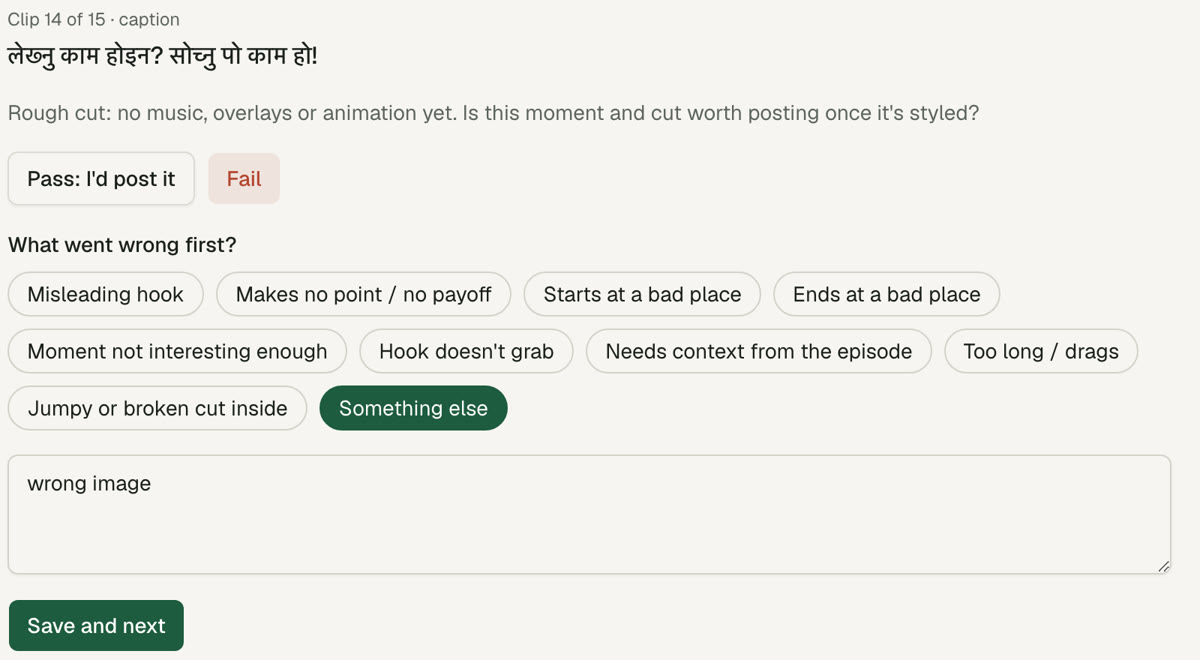
01
Watch the clip. Pass or fail.
One question per clip. I never saw which AI made it, so I judged the clip, not the model.
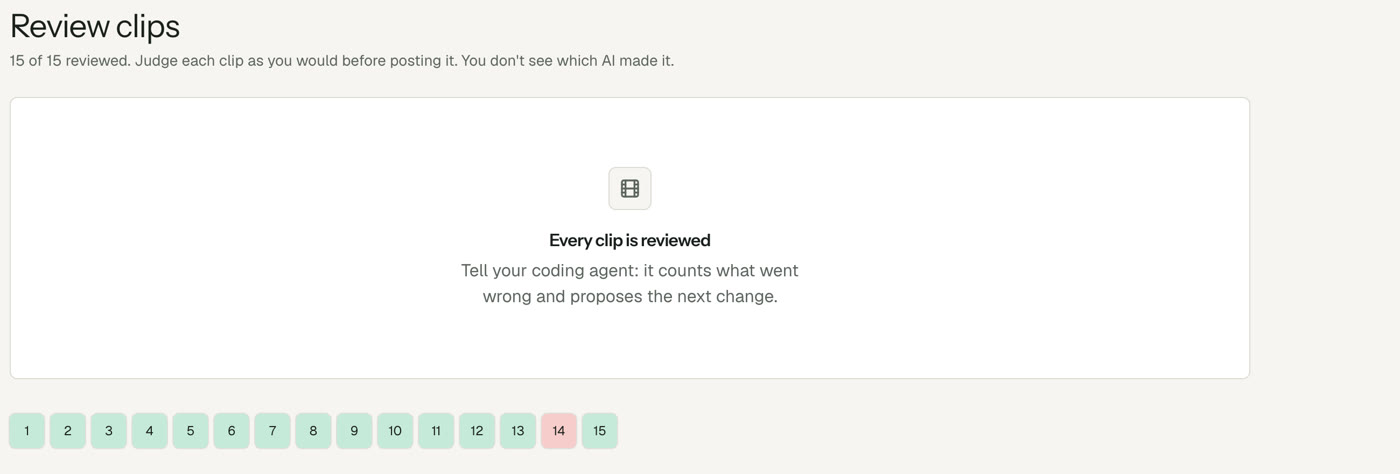
02
On a fail, say what went wrong first.
Pick a reason, add a few words. A round of 15 clips took me about 5 to 10 minutes.
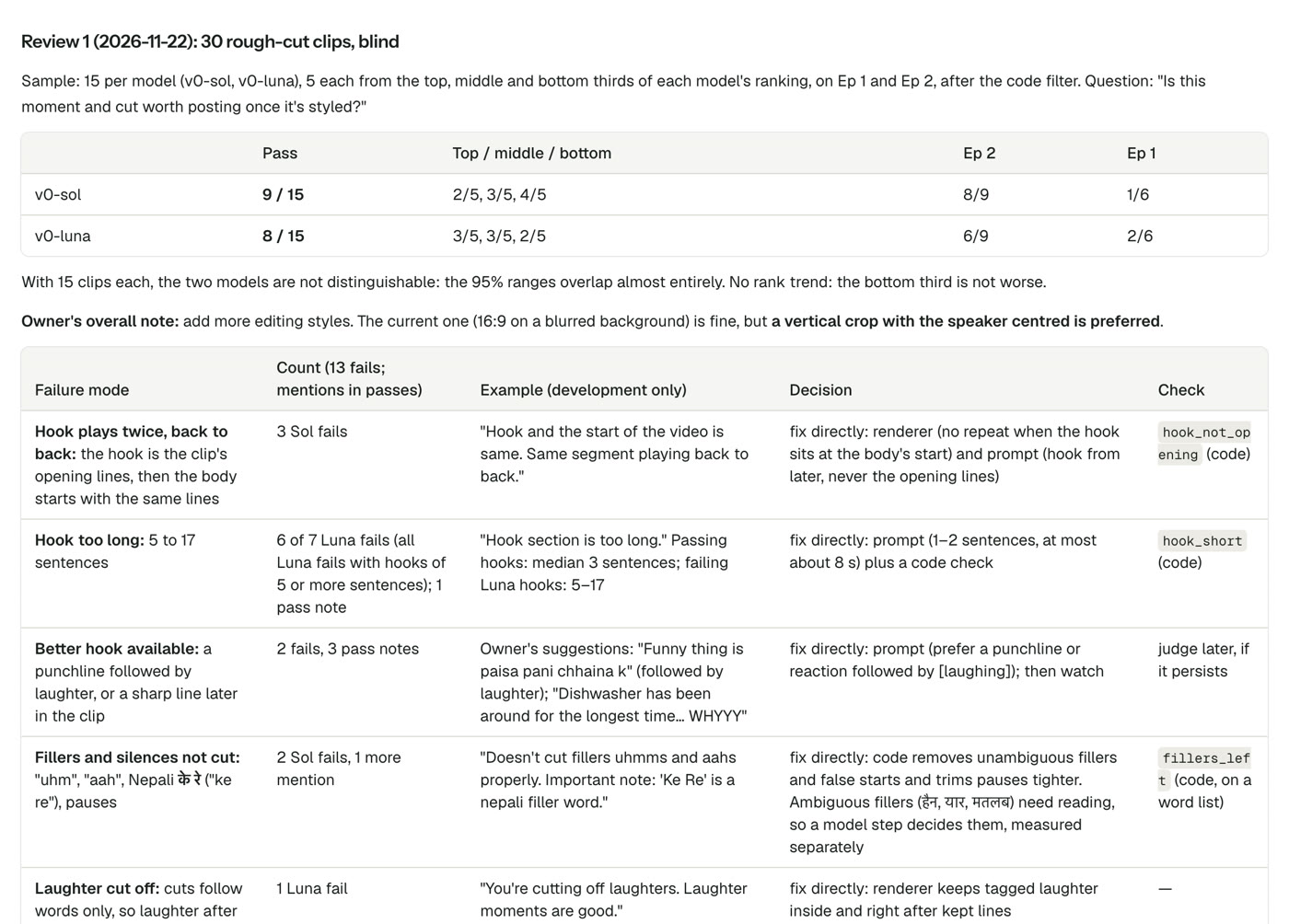
03
The agent turns my notes into a plan.
Every note lands in a table of problems: what it is, how often it happened, my exact words, and what happens next. Fix it now, add a check, or watch it. Nothing is guessed.
The method
Six habits, built into the template.
01
Say what good looks like
One pass/fail question about one clip. No vague goals.
1question
02
Spend cents, not weeks
Every run priced first and approved. Models compared on my real episodes.
$4.68whole experiment
03
Pass or fail. That was my job.
A built-in review lab. Blind, so I judged quality, not the model's name.
105clips in ~1 hour
04
Fix the worst first
My notes became counted problems. The biggest one got a dedicated fix.
6 → 0hook complaints
05
Never break what works
Each fix tested on old failures and old wins before it shipped.
57 → 93%postable
06
Ship it. Watch it. Improve it.
Every AI call recorded with its cost. Real use shows the next fix.
~1¢per clip
The results
Every round made it better.
57 → 93%
Clips I'd post exactly as they are, across three blind review rounds.
57%
Round 1
73%
Round 2
93%
Round 3
2.5×
faster to make each clip
79 seconds down to 31.
~3×
faster transcription on my laptop
A 77-minute episode in 11 minutes. Free and private.
50×
sharper subtitle timing
Words land on the beat, not two-thirds of a second late.


Drag to compare.
The first version dropped the whole wide shot onto a blurred background. My review notes asked for the speaker, front and centre. Now the frame follows whoever is talking, found by watching mouths move. Same moment, same camera.
It even caught the AI's own mistakes.
The agent once added a rule: hooks must come from at least 30 seconds into a clip. My favourite hook sat at 27 seconds. My reviews exposed it, and the rule was gone the same day, with the reason logged. When every decision is tested against your judgement, bad ideas don't last.
Today
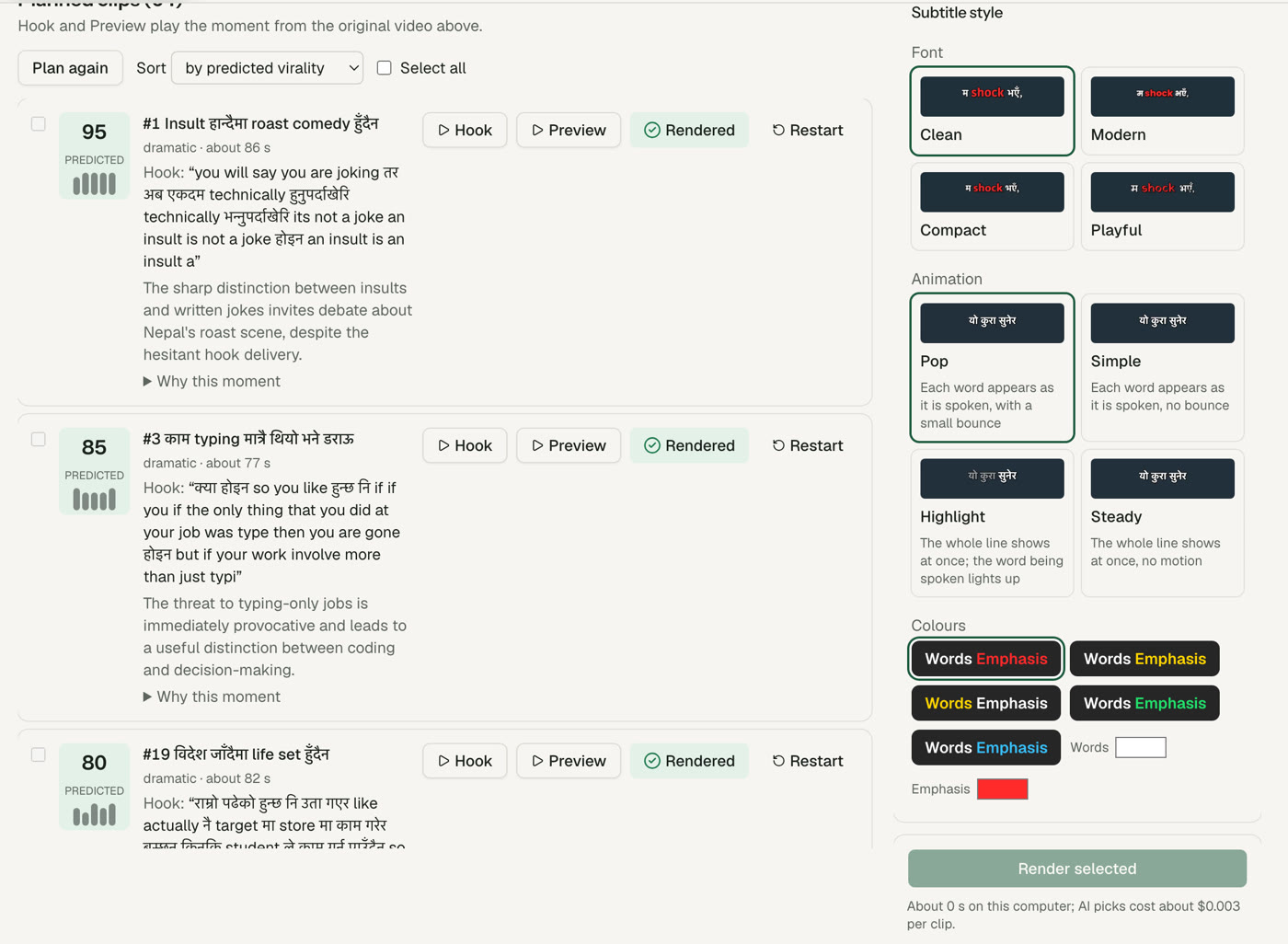
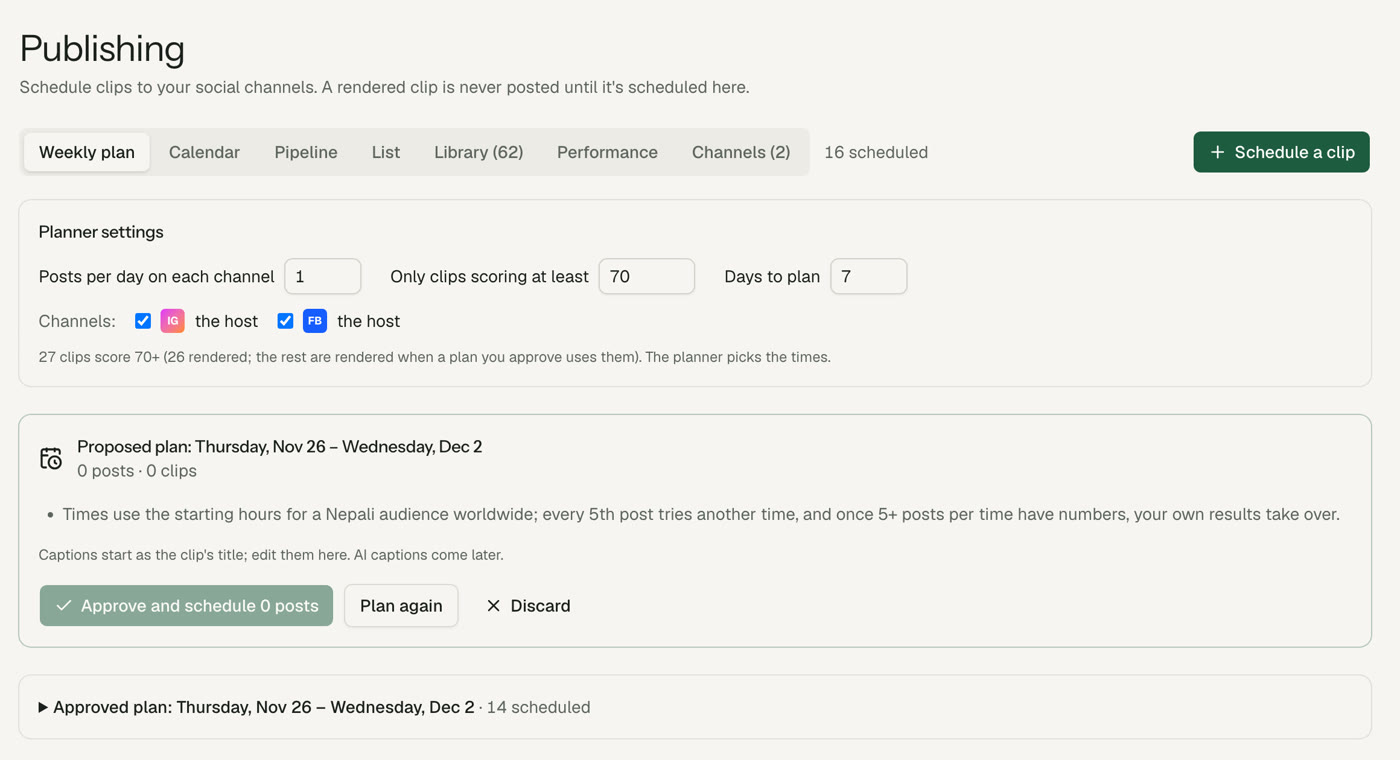
Paste a link. Pick the clips. Approve the week.
Out of the box
The hard parts of AI engineering were already solved.
Building the screens was the easy part. What usually takes a team is knowing whether the AI is any good, what it costs, and how to improve it without breaking it. The template answered each of those for me from day one.
“Is my AI actually any good?”
A review lab captures my judgement, and the agent turns it into checks it can run on every change.
“What is this costing me?”
The cost of every AI call is recorded, with budgets and approvals before any experiment spends money.
“Did this change break something?”
Each improvement is tested against past failures and past successes before it ships.
“Why did we choose this model?”
Every decision is logged with the options, the evidence and who decided, so nothing rests on a guess.
“How do I keep improving after launch?”
Results from real use point to the next thing to fix, and improvements arrive as changes I can review.
“Who does all this work?”
The coding agent, following the template's built-in process. I answered questions and made the calls.
Your idea. Your judgement. The AI engineering is built in.
AI Apps That Work is the codebase that is also your AI engineer. Test your AI on real examples, improve it round by round, and ship it knowing what every call costs.
$149 for the first 50 builders, then $249, paid once. 30-day refund.
Measured on my own episodes and laptop (Apple M1 Pro). “Under 24 hours” is active working time from the first conversation to clips being planned, rendered and scheduled. Speed gains compare the first working version with today. Cost per clip is the average over 125 clips. Chat excerpts are lightly trimmed.